
Find your inner peace
Welcome to meditationmastersasi.com, where your journey to inner peace begins. As a 7th generation Indian meditation master, I am dedicated to guiding you through transformative meditation practices. Explore our meditation classes and gatherings, designed to help you cultivate mindfulness and well-being. Join our community in Los Angeles, California, and embrace a legacy of tranquility.
Professor Sasi of India
Professor Sasi is committed to providing authentic meditation experiences rooted in a rich family tradition. Discover the benefits of meditation and how it can enhance your life. Join our classes and gatherings in Los Angeles, California, and experience the profound impact of mindfulness.

Our services
Meditation Gatherings and Private Meditation Instruction in person, online and on zoom.

About Professor Sasi
As a 7th generation Indian meditation master, I carry a legacy of mindfulness and inner peace. My mission is to share these ancient practices with you, helping you navigate life's challenges with clarity and serenity. Join me on this transformative journey and discover the profound benefits of meditation. Located in Los Angeles, California, I offer meditation classes and gatherings to support your well-being.
Voices of Peace
Meditation: A simple, fast way to reduce stress
Meditation can wipe away the day's stress, bringing with it inner peace. See how you can easily learn to practice meditation whenever you need it most.
If stress has you anxious, tense and worried, you might try meditation. Spending even a few minutes in meditation can help restore your calm and inner peace.
Anyone can practice meditation. It's simple and doesn't cost much. And you don't need any special equipment.
You can practice meditation wherever you are. You can meditate when you're out for a walk, riding the bus, waiting at the doctor's office or even in the middle of a business meeting.
Understanding meditation
Meditation has been around for thousands of years. Early meditation was meant to help deepen understanding of the sacred and mystical forces of life. These days, meditation is most often used to relax and lower stress.
Meditation is a type of mind-body complementary medicine. Meditation can help you relax deeply and calm your mind.
During meditation, you focus on one thing. You get rid of the stream of thoughts that may be crowding your mind and causing stress. This process can lead to better physical and emotional well-being.
Benefits of meditation
Meditation can give you a sense of calm, peace and balance that can benefit your emotional well-being and your overall health. You also can use it to relax and cope with stress by focusing on something that calms you. Meditation can help you learn to stay centered and keep inner peace.
These benefits don't end when your meditation session ends. Meditation can help take you more calmly through your day. And meditation may help you manage symptoms of some medical conditions.
Meditation and emotional and physical well-being
When you meditate, you may clear away the information overload that builds up every day and contributes to your stress.
The emotional and physical benefits of meditation can include:
- Giving you a new way to look at things that cause stress.
- Building skills to manage your stress.
- Making you more self-aware.
- Focusing on the present.
- Reducing negative feelings.
- Helping you be more creative.
- Helping you be more patient.
- Lowering resting heart rate.
- Lowering resting blood pressure.
- Helping you sleep better.
Meditation and illness
Meditation also might help if you have a medical condition. This is most often true if you have a condition that stress makes worse.
A lot of research shows that meditation is good for health. But some experts believe there's not enough research to prove that meditation helps.
With that in mind, some research suggests that meditation may help people manage symptoms of conditions such as:
- Anxiety.
- Asthma.
- Cancer.
- Chronic pain.
- Depression.
- Heart disease.
- High blood pressure.
- Irritable bowel syndrome.
- Sleep problems.
- Tension headaches.
Be sure to talk to your healthcare professional about the pros and cons of using meditation if you have any of these or other health conditions. Sometimes, meditation might worsen symptoms linked to some mental health conditions.
Meditation doesn't replace medical treatment. But it may help to add it to other treatments.
Types of meditation
Meditation is an umbrella term for the many ways to get to a relaxed state. There are many types of meditation and ways to relax that use parts of meditation. All share the same goal of gaining inner peace.
Ways to meditate can include:
-
Guided meditation. This is sometimes called guided imagery or visualization. With this method of meditation, you form mental images of places or things that help you relax.
You try to use as many senses as you can. These include things you can smell, see, hear and feel. You may be led through this process by a guide or teacher.
- Mantra meditation. In this type of meditation, you repeat a calming word, thought or phrase to keep out unwanted thoughts.
-
Mindfulness meditation.This type of meditation is based on being mindful. This means being more aware of the present.
In mindfulness meditation, you focus on one thing, such as the flow of your breath. You can notice your thoughts and feelings. But let them pass without judging them.
- Qigong. This practice most often combines meditation, relaxation, movement and breathing exercises to restore and maintain balance. Qigong (CHEE-gung) is part of Chinese medicine.
- Tai chi. This is a form of gentle Chinese martial arts training. In tai chi (TIE-CHEE), you do a series of postures or movements in a slow, graceful way. And you do deep breathing with the movements.
- Yoga. You do a series of postures with controlled breathing. This helps give you a more flexible body and a calm mind. To do the poses, you need to balance and focus. That helps you to focus less on your busy day and more on the moment.
Parts of meditation
Each type of meditation may include certain features to help you meditate. These may vary depending on whose guidance you follow or who's teaching a class. Some of the most common features in meditation include:
-
Focused attention. Focusing your attention is one of the most important elements of meditation.
Focusing your attention is what helps free your mind from the many things that cause stress and worry. You can focus your attention on things such as a certain object, an image, a mantra or even your breathing.
- Relaxed breathing. This technique involves deep, even-paced breathing using the muscle between your chest and your belly, called the diaphragm muscle, to expand your lungs. The purpose is to slow your breathing, take in more oxygen, and reduce the use of shoulder, neck and upper chest muscles while breathing so that you breathe better.
-
A quiet setting. If you're a beginner, meditation may be easier if you're in a quiet spot. Aim to have fewer things that can distract you, including no television, computers or cellphones.
As you get more skilled at meditation, you may be able to do it anywhere. This includes high-stress places, such as a traffic jam, a stressful work meeting or a long line at the grocery store. This is when you can get the most out of meditation.
- A comfortable position. You can practice meditation whether you're sitting, lying down, walking, or in other positions or activities. Just try to be comfortable so that you can get the most out of your meditation. Aim to keep good posture during meditation.
- Open attitude. Let thoughts pass through your mind without judging them.
Everyday ways to practice meditation
Don't let the thought of meditating the "right" way add to your stress. If you choose to, you can attend special meditation centers or group classes led by trained instructors. But you also can practice meditation easily on your own. There are apps to use too.
And you can make meditation as formal or informal as you like. Some people build meditation into their daily routine. For example, they may start and end each day with an hour of meditation. But all you really need is a few minutes a day for meditation.
Here are some ways you can practice meditation on your own, whenever you choose:
-
Breathe deeply. This is good for beginners because breathing is a natural function.
Focus all your attention on your breathing. Feel your breath and listen to it as you inhale and exhale through your nostrils. Breathe deeply and slowly. When your mind wanders, gently return your focus to your breathing.
-
Scan your body. When using this technique, focus attention on each part of your body. Become aware of how your body feels. That might be pain, tension, warmth or relaxation.
Mix body scanning with breathing exercises and think about breathing heat or relaxation into and out of the parts of your body.
- Repeat a mantra. You can create your own mantra. It can be religious or not. Examples of religious mantras include the Jesus Prayer in the Christian tradition, the holy name of God in Judaism, or the om mantra of Hinduism, Buddhism and other Eastern religions.
-
Walk and meditate. Meditating while walking is a good and healthy way to relax. You can use this technique anywhere you're walking, such as in a forest, on a city sidewalk or at the mall.
When you use this method, slow your walking pace so that you can focus on each movement of your legs or feet. Don't focus on where you're going. Focus on your legs and feet. Repeat action words in your mind such as "lifting," "moving" and "placing" as you lift each foot, move your leg forward and place your foot on the ground. Focus on the sights, sounds and smells around you.
-
Pray. Prayer is the best known and most widely used type of meditation. Spoken and written prayers are found in most faith traditions.
You can pray using your own words or read prayers written by others. Check the self-help section of your local bookstore for examples. Talk with your rabbi, priest, pastor or other spiritual leader about possible resources.
-
Read and reflect. Many people report that they benefit from reading poems or sacred texts and taking a few moments to think about their meaning.
You also can listen to sacred music, spoken words, or any music that relaxes or inspires you. You may want to write your thoughts in a journal or discuss them with a friend or spiritual leader.
- Focus your love and kindness. In this type of meditation, you think of others with feelings of love, compassion and kindness. This can help increase how connected you feel to others.
Building your meditation skills
Don't judge how you meditate. That can increase your stress. Meditation takes practice.
It's common for your mind to wander during meditation, no matter how long you've been practicing meditation. If you're meditating to calm your mind and your mind wanders, slowly return to what you're focusing on.
Try out ways to meditate to find out what types of meditation work best for you and what you enjoy doing. Adapt meditation to your needs as you go. Remember, there's no right way or wrong way to meditate. What matters is that meditation helps you reduce your stress and feel better overall.
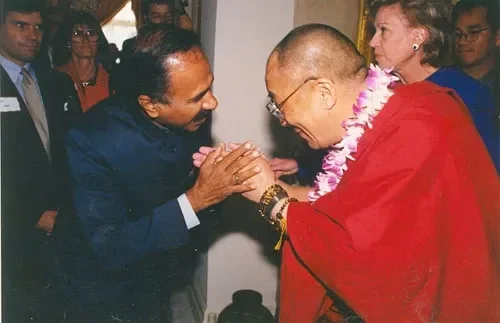
Professor Sasi with His Holiness Dalai Lama
MEDITATION INSTRUCTION is offered by Professor Sasi in person and online on skype, zoom and whatsapp
Meditation has long been viewed as an intricate and difficult practice; however meditation is a procedure which may be easily done by anyone anywhere in the world. Over time and with dedication the practitioner becomes adept at meditating.
For thousands of years in India, people have been doing various types of “vedic meditation,” based on the vedas, India’s spiritual books. The benefits of vedic meditation are numerous. Greater health,
Peacefulness, increased intuition, and even a keener mind are all some of the results of a meditation practice. The ultimate goal of vedic meditation is to achieve a sense of inner peace and wellbeing that will carry over into our daily lives, making us happier and stronger individuals able to manifest what we need and desire and to celebrate our lives.
As a young boy growing up in South India, Professor Sasi learned the skills and benefits of a daily meditation practice alongside his father who was a highly revered spiritual teacher and meditation master. Today Professor Sasi carries on the practice and wisdom imparted to him by his father, traveling abroad and sharing the ancient knowledge of meditation with people of different faiths and backgrounds. Professor Sasi presents meditation in a “user-friendly” style so that all may come to know meditation as a comfortable, accessible process that opens their own inner awareness, creating many blessings in life.
Many people choose to have regular meditation instruction with Professor Sasi in order to develop and/or strengthen their practice, to answer questions, and to learn different techniques.
- Meditation Techniques explored in Professor Sasi’s Classes include:
- Mantra Meditation – working with varied sacred Sanskrit sounds
- Om Meditation – using the primordial sound of creation
- Ujayee Meditation – using sound and breath together
- Pranayama Meditation – working with the breath
- Yoga Nidra Meditation – working with relaxing the body
- Creative Visualization Meditation – using the mind to consciously create
- 3rd Eye Meditation – using the 3rd eye (intuitive center) energy
- Sri Yantra Meditation – working with sacred geometric symbols
“Professor Sasi has the uninhibited talent to see the best in people around him. He is a catalyst who directs attention to your unused talents, potentialities and creativities. Sasi welcomes you to engage your own ability and awareness to live a fuller and richer life.”
Dr. Larry Payne, Ph.D., Director, Samata Yoga Center
I have had the good fortune to know Professor Sasi for over 30 years. Using his sacred gift of reading palms, he has helped me understand my true self and be prepared for whatever the future may bring. He lights up a room with his presence and is a pure joy to be with.
— Sam Sander
“To meet Sasi is a joy. He is natural, simple, direct and yet somehow so gentle that his words and tone belie the deepest teaching that one feels for days afterward. Sasi heals as he teaches.”
Dr. Theodore Goldman, Ph.D.
PHONE: 213 376 7236 : psychicprofessorsasi@gmail.com
Meditation gatherings and Private Meditation Instruction in person and on Zoom
Also please see: www.psychicprofessorsasi.com
Contact me
Location
Los Angeles, California
United States
Create Your Own Website With Webador